Knots & cord
Macramé — creative knots
Two knots, endless walls, plants that finally have somewhere to hang.
Macramé is knotting, not weaving: no loom, no needle, just cord and your hands. Almost everything you have admired — wall hangings, plant hangers, key rings, bracelets, napkin rings — is the square knot and the half hitch, repeated in a pattern. Learn both in ten minutes and spend the rest of the year decorating.
Square knot and half hitch
The square knot builds flat, braided panels. The half hitch, worked diagonally, draws the lines and chevrons that give macramé its graphic look. Everything else is a variation.
Cut cord about four times the finished length — knotting eats far more than people expect — and mount your work on a dowel or ring so the tension stays even from the first row.
Creativity in a Box — start knotting
Cord, ring or dowel, and step-by-step knot diagrams in the box.
Hangings, plant holders and mobiles
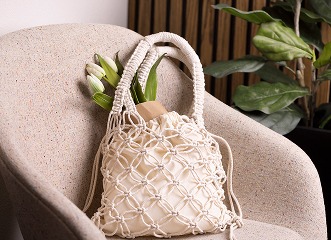
The pieces that soften a hard corner of a room — natural cord against white plaster.
Napkin rings, glass decoration and table pieces
Small knots, big table. The fastest way to make a dinner look considered.
Bracelets, earrings and key rings
Macramé at its smallest — and the best market-stall seller in the range.
How much cord do I need?
Roughly four times the finished length per strand, more if the pattern is dense. Our kits come pre-measured.
What is the difference between macramé and weaving?
Macramé is knotted by hand with no tool; weaving passes yarn over and under on a loom. Both hang beautifully — start with macramé if you want no equipment at all.
How do I finish the ends?
Trim level, then brush the strands out with a comb for the soft fringe look, or knot and tuck them behind the panel for a clean edge.